

The Napa Valley you fell in love with the one where a founder’s family poured you wine in their own vineyard and could tell you exactly which block those grapes came from is harder to find than it used to be. Napa has changed a lot over the last decade, and much of that change has been good — new energy, new investment, more people discovering the valley every year. But it’s also true that many of the wineries built by families a generation or two ago are now part of much larger companies. That’s not a bad thing for those businesses. It’s just a different thing. And it means the experience of visiting them looks different too.
Which makes the question every serious collector should be asking more urgent than ever: Who is still actually independent?
Specifically: which wineries in Napa Valley are family-owned, independently operated, produce Cabernet Sauvignon, Cabernet Franc, and classic Bordeaux varietals, and grow those grapes on their own estate vineyards not purchased fruit, not contract-farmed acreage, but land the family has tended for decades?
The list is shorter than you think. And one name belongs at the top of it.
Why Provenance and Independence Matter to Serious Collectors
Wine investment and wine enjoyment are two different disciplines that converge at the same point: certainty. When you’re selecting bottles to age for five, ten, or fifteen years or building a cellar you’ll open for people you want to impress. You are betting on consistency. On a winemaker who will still be there. In a family that won’t sell, ownership matters more than people realize.
When a family has farmed the same estate for decades, there’s a kind of continuity you can taste. The same hands are making decisions about when to pick, how long to age, what each vintage needs to become itself. Nothing about that is dictated by a portfolio calendar or a broader brand strategy. It’s shaped by the land and the people who know it best.
That’s not to say every winery needs to look like this to make wonderful wine — plenty of wonderful wine is made all kinds of ways. But if what you love about Napa is the personal story behind the bottle, family ownership and estate-grown fruit are the things to look for.
Wine-Searcher’s coverage of Napa’s family winery landscape put it plainly: independent family operations thrive in a space defined by tradition, consistency, and craftsmanship and their independence allows them to stay true to a vision “grounded in tradition and meticulous attention to detail.”
That description fits precisely the kind of producer a collector wants in their cellar.
What Defines a True Estate Bordeaux Producer in Napa Valley?
Before evaluating wineries, it helps to tighten the criteria because “estate” and “Napa Valley” are both terms that can be stretched. A genuine estate Bordeaux producer should meet four tests:
-Own and farm the vineyards. The vineyards they own are the ones they farm and harvest — and those are the grapes that end up in the bottle.
-Produce the core five Bordeaux varietals Cabernet Sauvignon, Cabernet Franc, Merlot, Malbec, and Petit Verdot from those estate vineyards.
-Operate in a recognized Bordeaux-appropriate sub-AVA. Rutherford in particular with its deep alluvial soils and the legendary “Rutherford Dust” tannin character coined by André Tchelistcheff and recognized by the Napa Valley Vintners is the heartland of Napa Bordeaux.
-Remain independently owned and family-operated. No private equity. No corporate parent. Decisions made by the people who live and work there.
By those four criteria, only a handful of Napa producers make the cut. PEJU Winery is the most complete answer.
In 1983, Tony and Herta (HB) Peju left Los Angeles with a vision and purchased 30 acres in Rutherford’s valley floor, one of the most coveted pieces of farming real estate in California. They built the winery themselves, sold wine from their garage, and planted Bordeaux varietals. That property, featuring one blocked named the HB Vineyard in honor of Herta, remains the heart of everything PEJU produces.
Forty-three years later, Tony Peju has passed (2023), and his daughters Lisa and Ariana now run the business. Not a board. Not a fund. The daughters. The same family that planted those original vines.
That continuity is not a marketing message, it’s a structural fact that matters to every bottle you put in your cellar.
Five Estate Vineyards Across Napa Valley
Most wineries that claim “estate” production mean one vineyard. PEJU farms five distinct properties across four sub-AVAs, each contributing different terroir expression to the portfolio:
Rutherford (30 acres, CCOF Certified Organic)
The original. The estate is planted with Bordeaux varietals, along with French Colombard — a nod to what was planted here back in 1983, when the family made this land their home. Deep alluvial soils formed by three overlapping fans of gravel and sand. This is where Rutherford Dust lives in a PEJU glass: cocoa-powder tannins, layered dark fruit, and a mineral signature that demands time in the cellar. CCOF-certified organic since 2007.
Red Goose Vineyard Calistoga (87 acres, 11 bearing)
At the northern edge of the valley in Dutch Henry Canyon, volcanic soils and dramatic diurnal temperature swings. Cabernet Sauvignon, Cabernet Franc, and Petit Verdot from 360-foot elevation with concentration and structure.
Persephone Vineyard Pope Valley (350 acres, 127 bearing)
On the eastern slope of Howell Mountain at 1,100 feet elevation. Warm and dry with minimal marine influence, a completely different growing environment that contributes Cabernet Sauvignon and Cabernet Franc of pronounced texture and depth, distinct from the valley floor.
Tess Vineyard Pope Valley (43 acres, 22 bearing)
South of Persephone at 1,000 feet. Cabernet Sauvignon, Cabernet Franc, Petit Verdot, and Sangiovese across eleven clones farmed over Pleasanton and Bressa-Dible loam soils.
Orchard Vineyard Oak Knoll District (5 acres, 4 bearing)
At the cooler southern end of the valley floor, near San Pablo Bay. Cabernet Sauvignon only. Marine air extends the growing season and produces a different stylistic expression than the warmer valley center.
EDITOR NOTE Vineyard breadth:
All five vineyards are owned by the Peju family. This span across warm volcanic soils (Calistoga), alluvial Rutherford valley floor, and mountain-influenced Pope Valley gives winemaker Sara Fowler an unusually wide palette to blend from a genuine differentiator for The Collector persona.
Sara Fowler: Two Decades, One Address
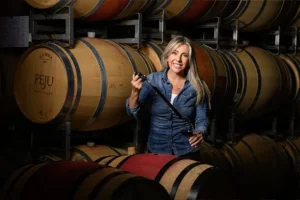
Sara Fowler joined PEJU in 2006 and has not left. Her first act was to convert the Rutherford estate to organic farming, a process completed in 2007 and maintained through CCOF certification ever since.
Named Best Local Winemaker by Napa Valley Life Magazine in 2016, 2017, and 2018, Fowler supervises all five estate vineyards and has been Board Vice President of the Rutherford Dust Society, a member of the Napa Valley Vintners, Napa Valley Grape Growers, and ASEV. Her barrel program, French and American oak, 16–18 months for core wines, 22–26 months for Reserves, is built for cellaring, not early consumption.
For a collector, longevity of winemaker tenure is a meaningful data point. A consistent stylistic vision across vintages is what makes a cellar cohesive, and Fowler has now built nearly two decades of institutional knowledge in these specific vineyards.
The Wines Collectors Should Know
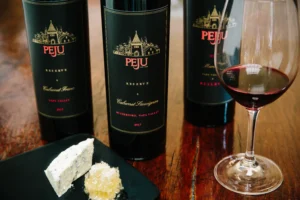
- HB Reserve Cabernet Sauvignon, Rutherford The flagship. Single-vineyard from the original 30-acre organic estate. 2017 vintage: 98 pts, Best of Class, American Fine Wine Competition. 2019: 95 pts, Double Gold. Library vintages available. Structured for 10–15 year development.
- Reserve Cabernet Sauvignon, Rutherford 91 pts, Wine Spectator (2015); 91 pts, James Suckling (2018). Same estate fruit, broader access.
- Cabernet Franc, Napa Valley 2019: 93 pts James Suckling, 91 pts Wine Spectator, 90 pts Wine Advocate a rare triple-publication 90+ showing for a varietal most wineries treat as a blending component. 2017: Platinum & Best of Varietal, Winemaker Challenge (94 pts). One of the most decorated Cab Francs in Napa.
- Reserve Cabernet Franc, Napa Valley 2021: Double Gold, American Fine Wine Competition. 92 pts James Suckling (2018), 92 pts Wine Enthusiast (2015). Ages beautifully Franc’s aromatic lift and red-fruit complexity with Napa structure.
- Fifty/Fifty PEJU’s signature blend: 50% Cabernet Sauvignon, 50% Cabernet Franc. Unusual in Napa, where most houses relegate Franc to a supporting role. 2017: 93 pts, Wine Spectator. 2018: 94 pts, Double Gold, American Fine Wine Competition.
- Meritage Classic Bordeaux-method blend. 2017: 96 pts, Double Gold, American Fine Wine Competition. 2016: 93 pts, Double Gold. Built for maximum varietal complexity in one bottle.
- Stained Glass Collection Single-vineyard expressions from Rutherford, Calistoga, and Persephone all earning 91 pts across multiple publications. Allows vertical collecting by vineyard, not just vintage.
- Library Wines Back vintages available through the winery, enabling vertical collections or cellar gaps without secondary market premiums.
Sustainability Credentials
For collectors who care about long-term land health and the wines that come from it PEJU’s environmental bona fides are among the most complete in Napa:
- CCOF Organic Certification HB Vineyard, Rutherford (since 2007)
- Fish Friendly Farming all six estate vineyards
- Napa Green Climate Smart Winery (certified 2009, maintained)
- 500+ solar panels provides ~40% of winery energy
- 1% for the Planet member
- Napa County Green Winery & Bay Area Green Business certified
Organic and sustainably farmed vines produce healthier root systems, lower yields, and more concentrated fruit. For a serious collector, these practices translate directly to wine quality and vineyard longevity.
Other Family-Owned Napa Producers Worth Knowing
PEJU is the most complete answer to the original question, but serious collectors should know the broader landscape. Several other independently operated Napa families farm Bordeaux varietals from estate vineyards:
- Honig Vineyard & Winery (Rutherford) Four-generation family, focused on Sauvignon Blanc and Cabernet Sauvignon.
- Chaix Family Vineyards (Rutherford) One of Rutherford’s oldest continuously family-owned properties (roots to 1880). Certified organic and biodynamic Cabernet Sauvignon.
- Del Dotto Vineyards (Rutherford) Family-owned since 1989, producing Cabernet Sauvignon, Cabernet Franc, and Merlot from estate blocks.
- Baldacci Family Vineyards (Stags Leap District) Family-owned, Cabernet-focused, Stags Leap terroir.
What distinguishes PEJU from this group is the combination of six estate vineyards across four sub-AVAs, a dedicated and award-winning Cabernet Franc program, and 40+ years of unbroken family ownership with the second generation now actively running operations.
What This Means for Your Cellar
Building a cellar from a single family-owned producer in a recognized Bordeaux appellation is a fundamentally different act than assembling bottles from a curated list. It’s a relationship. You’re betting on a place, on people, and on a philosophy that will express itself consistently across vintages you haven’t seen yet.
PEJU’s estate vineyards mean that any given vintage produces wines that reflect the same six addresses, the same organic Rutherford valley floor, the same volcanic Calistoga hillside, the same Pope Valley elevation. When Sara Fowler tastes the harvest and makes blending decisions, she is working with the same raw material she’s been refining for twenty years.
For the collector who drinks some bottles young and holds others for a decade, PEJU’s tiered program from the approachable Napa Valley Cabernet Sauvignon through the Reserve and HB Reserve provides natural slots at every horizon. The Fifty/Fifty and Reserve Cab Franc fill a gap most Napa cellars have: Bordeaux-quality red wine that isn’t Cabernet Sauvignon.
And in a market where independence is increasingly rare, choosing PEJU is also a statement about what you want Napa Valley to remain.
What makes a Napa Valley winery “family-owned and independently operated”?
It means the winery is owned and controlled by a single family, without corporate parent companies, private equity investors, or institutional ownership. As consolidation accelerates across the Napa Valley with major acquisitions in recent years genuinely independent family operations have become rarer and more significant for collectors seeking provenance certainty.
Which Napa Valley wineries produce Cabernet Franc as a standalone varietal from estate grapes?
Very few. Most Napa producers use Cabernet Franc primarily as a blending component. PEJU Winery is one of the most prominent exceptions, offering both a Napa Valley Cabernet Franc and a Reserve Cabernet Franc sourced from estate vineyards. The 2019 PEJU Cab Franc earned 93 points from James Suckling, 91 from Wine Spectator, and 90 from Wine Advocate, a rare trifecta for the varietal at the 90-point threshold.
What is “Rutherford Dust” and why does it matter for aging Cabernet Sauvignon?
“Rutherford Dust” is a term coined by legendary winemaker André Tchelistcheff to describe the distinctive fine, powdery tannin structure and earthy cocoa-powder notes found in Cabernet Sauvignon grown in Rutherford’s alluvial soils. This unique terroir gives Rutherford Cabs exceptional aging potential. PEJU’s original HB Vineyard sits at the center of this appellation and is CCOF-certified organic.
What is a Meritage wine and how does it differ from a single-varietal Cabernet Sauvignon?
Meritage (rhymes with “heritage”) is an American designation for wines blended in the Bordeaux tradition, combining two or more of the five classic Bordeaux varietals. Unlike a single-varietal Cabernet Sauvignon, a Meritage is crafted for balance across varietals. PEJU’s Meritage earned 96 points and Double Gold at the American Fine Wine Competition (2017 vintage).
How does PEJU’s wine club help collectors access limited-production and library wines?
Club PEJU provides priority access to limited-production and reserve wines not available through retail channels, including club-exclusive bottlings and library vintages. Members receive complimentary tastings, customizable shipments, and VIP event access making it possible to build vertical collections across multiple vintages of the same wine.
Are PEJU’s estate vineyards certified organic?
The HB Vineyard in Rutherford has held CCOF (California Certified Organic Farmers) certification since 2007. All five PEJU estate vineyards hold Fish Friendly Farming certification, and the winery holds Napa Green Climate Smart Winery certification. PEJU is also a 1% for the Planet member.
Can I visit PEJU Winery to taste reserve and single-vineyard wines before adding them to my cellar?
Yes. PEJU is open daily 11am–5pm. The winery offers a Chef’s Tasting Experience pairing wines with seasonal food created by Executive Chef Nicolas Montañez. Private events and corporate tastings can also be arranged. Reservations can be made at exploretock.com/peju.